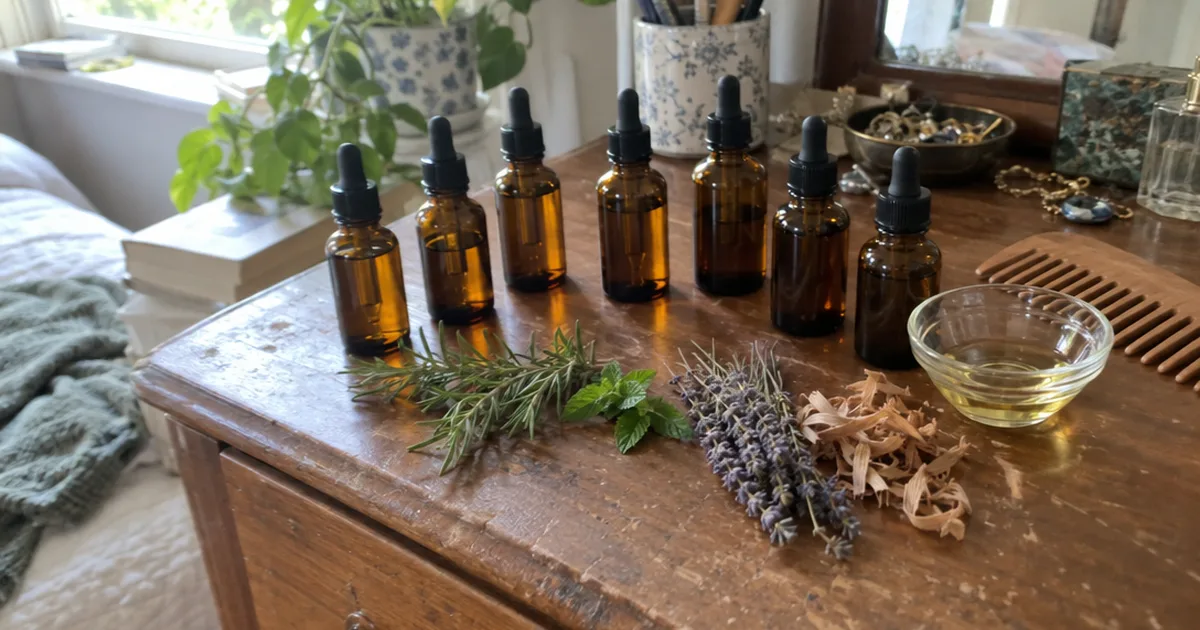

A perfume made only of citrus oils can fade from your skin within minutes. That’s because every essential oil evaporates at its own speed, and essential oil perfume notes sort oils by that speed.
Get the notes right and your blend opens bright, settles into something soft and still smells good hours later. Here’s which oils belong in each layer and how to balance them.
What Are Essential Oil Perfume Notes?
Essential oil perfume notes are the three layers of a scent, top, middle and base, grouped by how quickly each oil evaporates from your skin. A perfume is a mixture of aroma compounds that leave at different speeds, so your sense of smell catches the light ones first while heavy ones linger.
Perfumers draw this as a fragrance pyramid. The narrow top is what you smell first, the wide middle is the body, and the base holds everything up.
So a note isn’t a smell category. It’s a timing category.
That’s why a one-layer blend feels thin: all citrus gives you a burst and then nothing, while all base notes smell heavy right out of the bottle.
Top Notes: The First Thing You Smell
Top notes are the light, fast-evaporating essential oils you smell first, mostly citrus such as bergamot, lemon, grapefruit and sweet orange, plus sharp herbs like peppermint and basil. They usually fade within minutes.
Their job is the first impression. Many are pressed from fruit peel rather than distilled, and mandarin and lime behave the same way.
Because they vanish first, top notes always need a middle and a base under them, or the blend disappears with them.
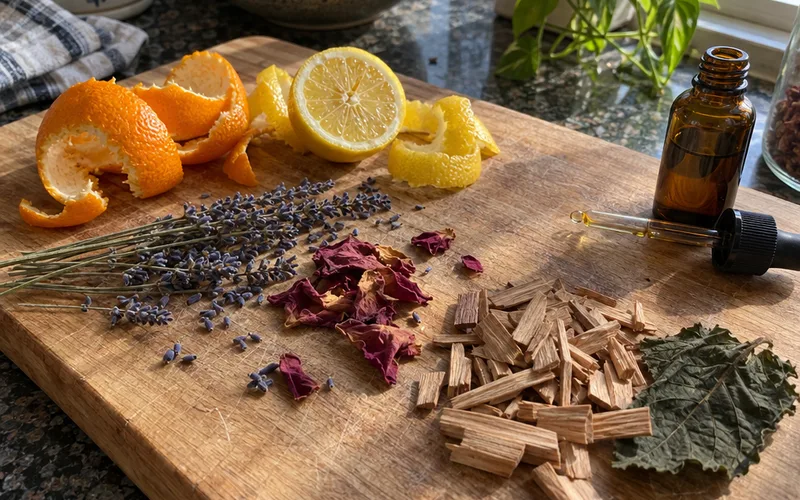
Bergamot is the favorite because its soft, floral edge bridges into the middle layer. Read what bergamot smells like before you buy a bottle.
Middle Notes: The Heart of the Blend
Middle notes, also called heart notes, are the essential oils that carry a perfume for the first few hours, mostly floral scents and soft herbs such as lavender, rose, jasmine, geranium, ylang-ylang and rosemary. They show up as the top notes fade.
This is the layer people remember. When you call a perfume “floral” or “herbal,” you’re describing its heart.
Middle notes also smooth the edges, filling the gap between a sharp citrus top and an earthy base. Warm spices such as cinnamon, nutmeg and clove can sit here too, in tiny amounts.
If your blend smells like something is missing, add a middle note first.
Base Notes: The Scent That Stays
Base notes are the heavy, slow-evaporating essential oils that linger longest on your skin, often for many hours, such as sandalwood, cedarwood, vetiver, patchouli, frankincense and myrrh. They anchor the whole perfume.
You barely notice them at first. They come forward as the lighter oils evaporate, which is why the dry-down smells warmer than the start.
Heavy oils like patchouli also act as fixatives: they slow how fast the lighter oils evaporate, so the whole blend lasts longer.
Vetiver shows how strong a base note can be. Its earthy, rooty smell can take over a blend, so start with a single drop.
Essential Oil Notes Chart
The essential oil notes chart below groups common perfume oils by layer, with how each layer smells and roughly how long it lasts on skin:
| Note | Essential oils | Scent | Lasts |
|---|---|---|---|
| Top | Bergamot, lemon, grapefruit, sweet orange, peppermint | Fresh, bright | Minutes |
| Middle | Lavender, rose, jasmine, geranium, ylang-ylang | Floral, herbal | A few hours |
| Base | Sandalwood, cedarwood, vetiver, patchouli, frankincense | Woody, earthy | Many hours |
Some oils sit between layers. Lavender can read as a top-to-middle note and frankincense as a middle-to-base note, depending on what you blend them with.
That’s because a note’s place is relative. Next to bergamot, lavender acts like a heart note, but next to sandalwood it can smell almost bright.
How to Balance Top, Middle and Base Notes
A common starting ratio for an essential oil perfume is about 30% top notes, 50% middle notes and 20% base notes. Many blending guides use this split because it gives a bright opening, a full heart and a base that holds the scent without taking over.
For a 10-drop test blend, that’s 3 drops of bergamot, 5 drops of lavender or geranium and 2 drops of cedarwood or sandalwood.
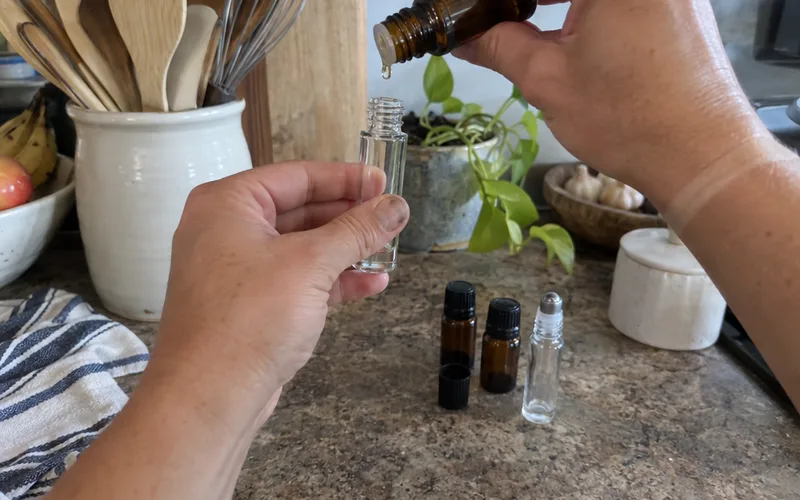
Then adjust by smell. Vetiver, patchouli and ylang-ylang are strong, so they often need fewer drops than the ratio suggests.
How to Build Your First Essential Oil Perfume
To build your first essential oil perfume, pick one oil from each layer, mix a small test blend, let it rest, then dilute it in a carrier oil or perfumer’s alcohol before it touches your skin. Three is enough to learn what each one adds.
Here’s the process:
- Choose a scent family you like, such as floral, woody or citrus.
- Pick one top, one middle and one base oil from the chart.
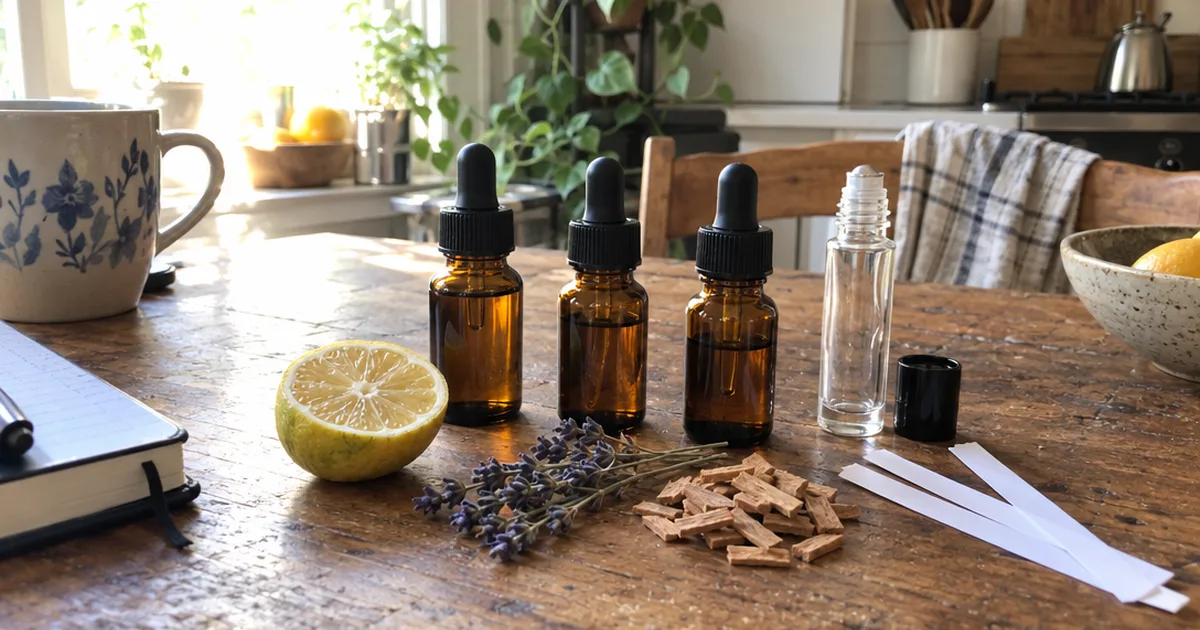
- Mix a 10-drop test in a glass vial, base first, then middle, then top.
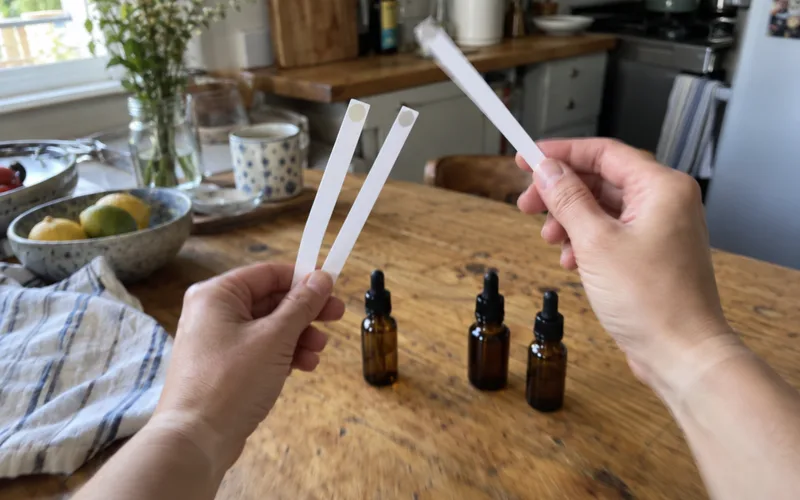
- Smell it on a paper strip over an hour to see how it changes.
- Let it rest for a day or two so the oils soften and merge.
- Dilute it before wearing it in a carrier oil for perfume for a roller, or in alcohol for a spray.
Not sure which oils to try? These starter pairings follow the same top, middle and base pattern:
| Mood | Top note | Middle note | Base note |
|---|---|---|---|
| Fresh | Grapefruit | Rosemary | Cedarwood |
| Floral | Bergamot | Rose or geranium | Sandalwood |
| Warm | Sweet orange | Ylang-ylang | Patchouli |
| Calm | Bergamot | Lavender | Vetiver |
Once a pairing works, swap one ingredient at a time. The essential oil perfume recipes and the guide to making perfume with alcohol give full amounts, and the best oils for perfume making cover single oils in more depth.
Is Essential Oil Perfume Safe on Your Skin?
Essential oil perfume is safe on skin for most adults when it’s diluted, patch tested first and kept off sun-exposed skin if it contains pressed citrus oils. Undiluted oils can irritate skin.
Pressed bergamot and some other cold-pressed citrus contain compounds that can make skin burn or darken in sunlight. For a daytime perfume, look for bergamot labeled FCF (furocoumarin-free), or wear the blend under clothing.
Before you wear a new blend:
- Dilute it, never neat. The dilution guide gives drop counts.
- Patch test your inner arm and wait a day.
- Skip broken or freshly shaved skin.
- Keep blends away from babies and young children.
Note: If a blend makes your skin red or itchy, wash it off with soap and water and stop using it.
The essential oil safety guide covers the full rules, and you can check whether essential oils work as skin perfume on their own.
Essential Oils vs Fragrance Oils in Perfume
Essential oils are distilled or pressed from a single plant, while fragrance oils are blended scents that often mix natural and synthetic materials. Both can go into a homemade perfume.
Fragrance oils can copy smells plants don’t give up as an oil, such as fresh lily, musk or amber. And some shop “oils” aren’t essential oils at all: vanilla is sold as an extract or absolute, and jasmine and rose often come as absolutes.
Read the label for the plant’s name and how it was made, and see essential oil vs fragrance oil before you mix the two.
Start With Three Oils
The simplest way to learn essential oil perfume notes is to blend one top, one middle and one base oil and smell how they change over an hour.
Pick a starter pairing from the table and mix your first 10-drop test this week.
Frequently Asked Questions
Can essential oils be used as a perfume?
Yes, essential oils can be used as a perfume once they’re diluted in a carrier oil or perfumer’s alcohol, never applied neat. A blend of a top, middle and base note smells more finished than a single oil.
Which essential oils smell like perfume?
The essential oils that smell most like perfume are florals such as rose, jasmine and ylang-ylang, plus warm base notes such as sandalwood and patchouli. Pair one with a citrus top note for a rounder scent.
Which essential oil has top notes?
Citrus essential oils are the classic top notes, especially bergamot, lemon, grapefruit and sweet orange. Peppermint, eucalyptus and basil act as top notes too because they evaporate quickly.
What essential oils are used for perfume?
The essential oils used most in perfume are citrus oils such as bergamot on top, lavender, rose, jasmine and geranium in the middle, and sandalwood, cedarwood, vetiver and patchouli at the base. Start with one oil from each layer.
Where should you apply essential oil perfume?
Apply essential oil perfume to warm pulse points such as your wrists, the base of your throat and behind your ears, where body heat helps the scent rise.