
Peppermint oil’s 92% hair growth result came from shaved mice.
Yet that 2014 study is the whole basis for the popular claim that peppermint beats minoxidil.
So I ranked 7 essential oils for hair by the strength of their human evidence, from a real trial down to lab work.
Pick by your problem:
- Thinning on top or a widening part: #1.
- Flakes on your shoulders and an itchy scalp: #2, with #7 as the backup.
- An oily scalp by day 2: #5.
- Patchy hair loss a doctor called alopecia areata: #6, alongside your treatment.
The 7 Best Essential Oils for Hair at a Glance
Tap a button to jump straight to that oil.
| # | Oil | Best for | Best evidence | Go |
|---|---|---|---|---|
| 1 | Rosemary | Thinning hair | Human trial, hair count | See Pick |
| 2 | Tea tree | Dandruff and itchy scalp | Human trial, dandruff | See Pick |
| 3 | Lavender | Blending with rosemary | Human blend trial, mice | See Pick |
| 4 | Peppermint | A cooling scalp massage | Mice only | See Pick |
| 5 | Cedarwood | Oily scalp | Human blend trial | See Pick |
| 6 | Thyme | Alopecia areata, with a doctor | Human blend trial | See Pick |
| 7 | Lemongrass | Backup for flaking | Review of a dandruff tonic | See Pick |
The 7 Best Essential Oils for Hair, Ranked by Evidence
Each pick gives who it suits, the proof and the honest catch.
1. Rosemary [Best for Thinning Hair]
Rosemary is the one essential oil tested on human hair counts, so try it first if your part is widening.
| Rosemary at a Glance | |
|---|---|
| 🔬 Best Evidence | 1 human trial, 100 men, 6 months |
| 🧴 Mix | 1% to 3% in a carrier oil |
| 🎯 Best For | Early thinning at the crown or part |
| ⚠️ Skip It If | You need proven regrowth |
A 2015 study randomized 100 men with pattern hair loss to rosemary oil or 2% minoxidil twice a day for 6 months, reports dermatologist Ben Behnam of Happy Head. Both groups gained hair by month 6, with no significant difference between them.
The catch?
The trial had no placebo group, only men with androgenetic alopecia, and no change in either group at 3 months. So rosemary is worth a 6-month try, not a swap for a prescription that’s working.
Once you start, check whether you can use rosemary oil every day without irritating your scalp.
2. Tea Tree [Best for Dandruff and Itchy Scalp]
Tea tree oil is the pick for flakes, thanks to its anti-inflammatory and antimicrobial properties.
It has its own scalp trial, but it isn’t a hair growth oil.
| Tea Tree at a Glance | |
|---|---|
| 🔬 Best Evidence | 1 human trial, 126 people, 4 weeks |
| 🧴 Mix | A ready-made tea tree shampoo |
| 🎯 Best For | Mild to moderate dandruff and itchiness |
| ⚠️ Skip It If | Your goal is thicker hair |
In a 2002 trial, 126 people with dandruff used a 5% tea tree oil shampoo or a placebo for 4 weeks. The tea tree group improved 41% on a dandruff severity score, against 11% for placebo, Behnam reports.
That’s nearly 4 times the improvement of the placebo shampoo.
Here’s how to use it:
- Buy a shampoo that lists tea tree oil as an ingredient, rather than dosing a bottle yourself.
- Lather it into your scalp, then rinse well.
- Give it 4 weeks, the length of the trial, before you judge it.
Tea tree oil can cause rashes and skin irritation, warns a medically reviewed Healthline guide, so stop if your scalp burns. The benefits of tea tree oil shampoo go deeper, and if flakes are your only problem, compare every essential oil for dandruff.
3. Lavender [Best Blend Partner]
Lavender oil is the only oil with both a human blend trial and its own animal study, which makes it the strongest partner for rosemary.
| Lavender at a Glance | |
|---|---|
| 🔬 Best Evidence | Human blend trial; mice alone |
| 🧴 Mix | Part of a 1% to 3% blend |
| 🎯 Best For | A nightly scalp massage blend |
| ⚠️ Skip It If | Lavender has ever made your skin itch |
In a 1998 double-blind study, 86 patients massaged thyme, rosemary, lavender and cedarwood oils into their scalps nightly for 7 months. Nineteen of 43 in the oil group (44%) improved, against 6 of 41 on carrier oils alone (15%), he reports.
But those patients had alopecia areata, an autoimmune condition, not pattern thinning. And the 4 oils were never tested apart.
Alone, lavender has only mouse data: in a 2016 study, 3% and 5% lavender oil raised follicle number and depth in 4 weeks. It’s generally safe, though some people develop an allergic reaction to it, Healthline notes.
4. Peppermint [Best for a Cooling Scalp Massage]
People love peppermint essential oil for its tingle, but its hair growth claims rest on mice, so it ranks #4.
| Peppermint at a Glance | |
|---|---|
| 🔬 Best Evidence | 1 mouse study, 4 weeks |
| 🧴 Mix | Start at 1% |
| 🎯 Best For | A wake-up scalp massage |
| ⚠️ Skip It If | Your scalp is sensitive or has inflammation |
That tingle comes from menthol, which feels cold on skin.
In a 2014 study, mice given 3% peppermint oil reached about 92% hair growth in 4 weeks, against 55% for minoxidil, the Happy Head review notes. No human hair-count trial of peppermint exists yet.
Want the tingle and the evidence? Mix 1 drop of peppermint and 2 drops of rosemary into 1 tablespoon of carrier oil, a 1% blend.
5. Cedarwood [Best for an Oily Scalp]
Cedarwood suits roots that look greasy a day after washing. It’s thought to balance the glands that make sebum, says the same Healthline guide.
| Cedarwood at a Glance | |
|---|---|
| 🔬 Best Evidence | Human blend trial only |
| 🧴 Mix | Part of a 1% to 3% blend |
| 🎯 Best For | Oily roots and a woody scent |
| ⚠️ Skip It If | You want an oil with its own trial |
Cedarwood was one of the 4 oils in the 1998 blend trial at #3, its only human hair evidence. So use it the way that trial did, in a blend:
- 1 tablespoon of jojoba oil
- 1 drop each of rosemary, lavender and cedarwood, a 1% blend
- A slow scalp massage every night, as in the trial
The cedarwood oil for hair guide covers its scent and sourcing.
6. Thyme [Best for Alopecia Areata Blends]
Thyme’s only hair evidence is that same 1998 blend trial, so it matters most if a doctor has diagnosed alopecia areata.
| Thyme at a Glance | |
|---|---|
| 🔬 Best Evidence | Human blend trial, 7 months |
| 🧴 Mix | Keep it to 1% |
| 🎯 Best For | Alopecia areata, beside your treatment |
| ⚠️ Skip It If | You have pattern thinning instead |
That trial’s 44% versus 15% result has a twist. Alopecia areata clears up on its own in a fair share of cases, and no one knows which oil did the work.
So don’t use thyme alone.
Here’s what to ask your dermatologist: “I’d like to try the rosemary, lavender, cedarwood and thyme scalp blend from a 1998 trial. Is that safe with my current treatment?”
7. Lemongrass [Best Backup for Flaking]
Lemongrass is the second dandruff option when tea tree irritates your skin, likely thanks to an anti-fungal effect, though its evidence is thinner.
| Lemongrass at a Glance | |
|---|---|
| 🔬 Best Evidence | A 2024 review of a 10% tonic |
| 🧴 Mix | 1% to 3% at home |
| 🎯 Best For | Flaking when tea tree stings |
| ⚠️ Skip It If | Tea tree already works for you |
A 2024 review suggests a tonic with 10% lemongrass essential oil may help reduce and manage dandruff, Healthline reports.
Note: That 10% was a made-for-study formula, over 3 times the 3% ceiling for anything left on your scalp. At home, stay within the chart below.
The lemongrass oil for hair guide covers how to blend it.
How We Ranked These Oils
A human trial on hair count beat a trial on scalp health, then a blend trial, then animal studies, then lab work. I didn’t test these oils myself.
No essential oil is approved by the FDA to treat hair loss, Behnam points out, so the evidence, not the label, sets the order.
How to Mix Essential Oils for Your Hair
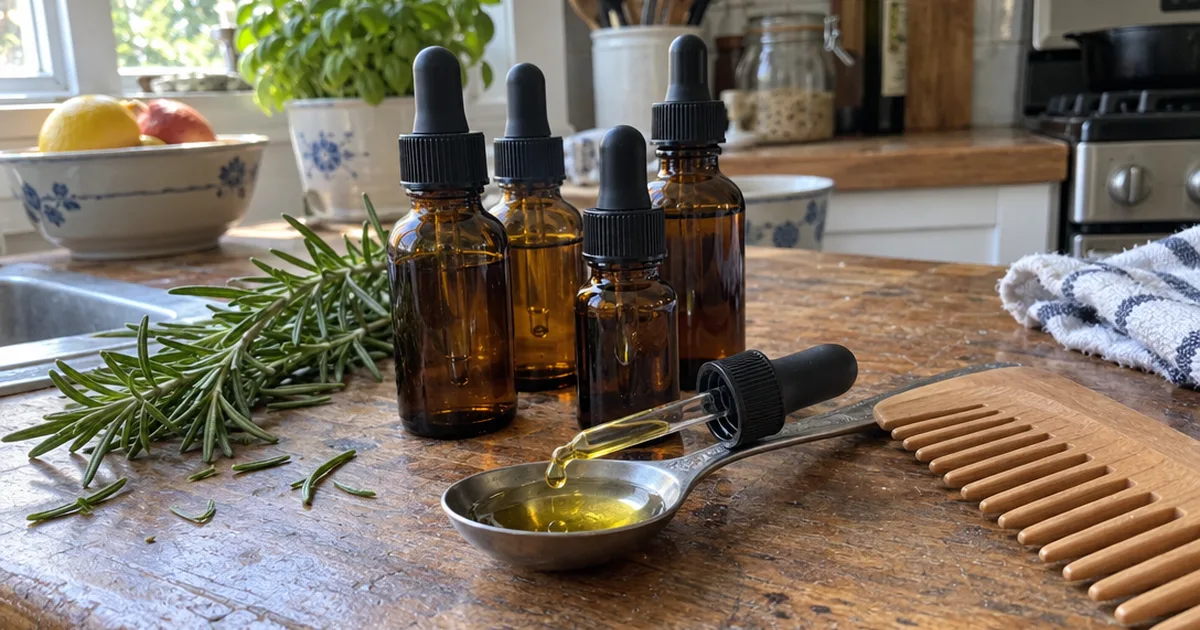
Mix essential oils for hair at 1% to 3% in a carrier oil, which is 3 to 9 drops per tablespoon, and never put them on your scalp straight from the bottle. Dilution is the first rule of using essential oils anywhere on your body.
How Many Drops per Tablespoon
Use 3, 6 or 9 drops per tablespoon of carrier oil for a 1%, 2% or 3% mix, Behnam advises. Per fluid ounce, that’s 6, 12 or 18 drops.
Start at 1% for a first try or a sensitive scalp, and stay at or below 3% for anything you leave on. The full guide to diluting essential oils covers other uses.
Which Carrier Oil to Use
Jojoba oil, Grapeseed oil and Coconut oil are the carriers Behnam names for scalp blends.
Castor oil, Argan Oil, Olive oil, almond and Avocado oils turn up in hair recipes too, but the 1998 trial blend used jojoba and grapeseed. The best carrier oils for hair growth are compared there.
Adding Oils to Shampoo
Stir 3 to 6 drops into 1 tablespoon of unscented shampoo or conditioner for a 1% to 2% mix, and use it right away. Mixing per wash lets you stop the moment your scalp complains.
Store your bottles in amber or cobalt glass, because light breaks oils down.
How Long Do Essential Oils Take to Work on Hair?
Essential oils take about 6 months to show hair growth and about 4 weeks to ease dandruff, the lengths of the 2015 rosemary trial and the 2002 tea tree trial. In the rosemary trial, hair counts hadn’t moved at 3 months and rose by month 6.
Take a photo of your part in the same light each month to judge it. No human evidence shows any essential oil regrowing hair from follicles that have already shrunk or scarred, Behnam says.
If you use minoxidil, apply it and your oil blend at different times of day so the oil doesn’t dilute it. Minoxidil, finasteride and dutasteride are the treatments with repeated large human trials for pattern thinning.
Which Essential Oils Should Not Be Used on Hair?
No essential oil should go on your scalp undiluted, photosensitizing oils shouldn’t go on before time in the sun, and lavender, tea tree and peppermint need extra care around children. For adults, the 2 safety steps that matter most are dilution and a 48-hour patch test.
The bigger risks depend on who’s using the oil, and the full essential oils safety rules cover them oil by oil.
Patch Test for 48 Hours
Dab your diluted mix on your inner forearm, cover it and check it after 48 hours. Allergic contact dermatitis shows up late, so a clear arm at 20 minutes tells you nothing.
Repeat the test whenever you change the oil, brand, batch or strength.
Children, Pregnancy and Sensitive Scalps
Only older teens and adults should use essential oils on their hair, Healthline advises. Peppermint should never go on a child’s face, because it can cause trouble breathing.
Case reports also link topical lavender and tea tree oil to breast growth in boys. Three cases don’t prove it, but they’re reason enough to keep those 2 oils off children.
If you’re pregnant or breastfeeding, have eczema, psoriasis or an inflamed scalp, or use a prescription scalp treatment, ask your doctor first. The rules for aromatherapy in pregnancy cover which oils to avoid.
Other Oils You’ll See Recommended for Hair
Pumpkin seed oil is not an essential oil: it’s a fixed oil like jojoba, and its hair research tested a capsule you swallow, not oil on the scalp. It still shows up on many hair care oil lists.
Ylang-ylang, Clary Sage and geranium have no standalone human trial for hair growth either, Behnam notes in his review, updated in August 2026. The other common ones get their own pages:
- Clove oil for hair
- Oregano oil for hair
- Eucalyptus oil for hair
- Frankincense oil for hair
- Jasmine oil for hair
- Geranium oil for hair
- Orange oil for hair
If regrowth is your only goal, the ranking of the best essential oils for hair growth narrows the field.
The Bottom Line
Rosemary oil for thinning hair and tea tree oil for dandruff are the best essential oils for hair, the only 2 with their own human trials.
This week, mix 3 drops of rosemary into 1 tablespoon of jojoba oil and patch test it for 48 hours.
Then give it 6 months before you judge it.
Frequently Asked Questions
Can you put essential oils directly on hair?
No, never put an essential oil on your hair or scalp straight from the bottle. Dilute it to 1% to 3% in a carrier oil, 3 to 9 drops per tablespoon, and patch test it for 48 hours.
Which 5 oils are best for hair growth?
Rosemary, lavender, peppermint, cedarwood and thyme are the 5 essential oils most studied for hair growth. Only rosemary has its own human hair-count trial.
What is the best oil to use for dry scalp and dandruff?
Tea tree oil is the best essential oil for dandruff: a 5% tea tree shampoo cut dandruff scores 41% in 4 weeks, against 11% for a placebo. Lemongrass is the backup if tea tree irritates you.
Does rosemary oil really work as well as minoxidil?
Not proven: rosemary oil showed no significant difference from 2% minoxidil in one 6-month trial of 100 men. That trial had no placebo group and saw no change in either group at 3 months.
Are essential oils safe for hair during pregnancy or for children?
Essential oils on the scalp suit older teens and adults, and anyone pregnant or breastfeeding should ask their doctor first. For kids, skip lavender and tea tree, and never put peppermint near a child’s face.