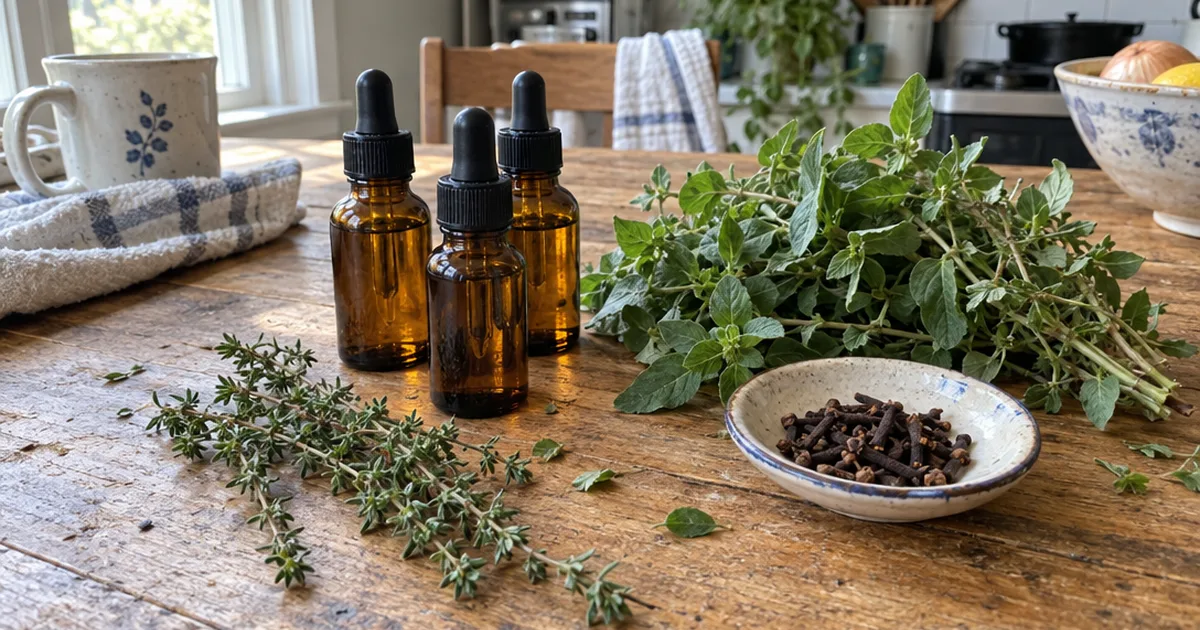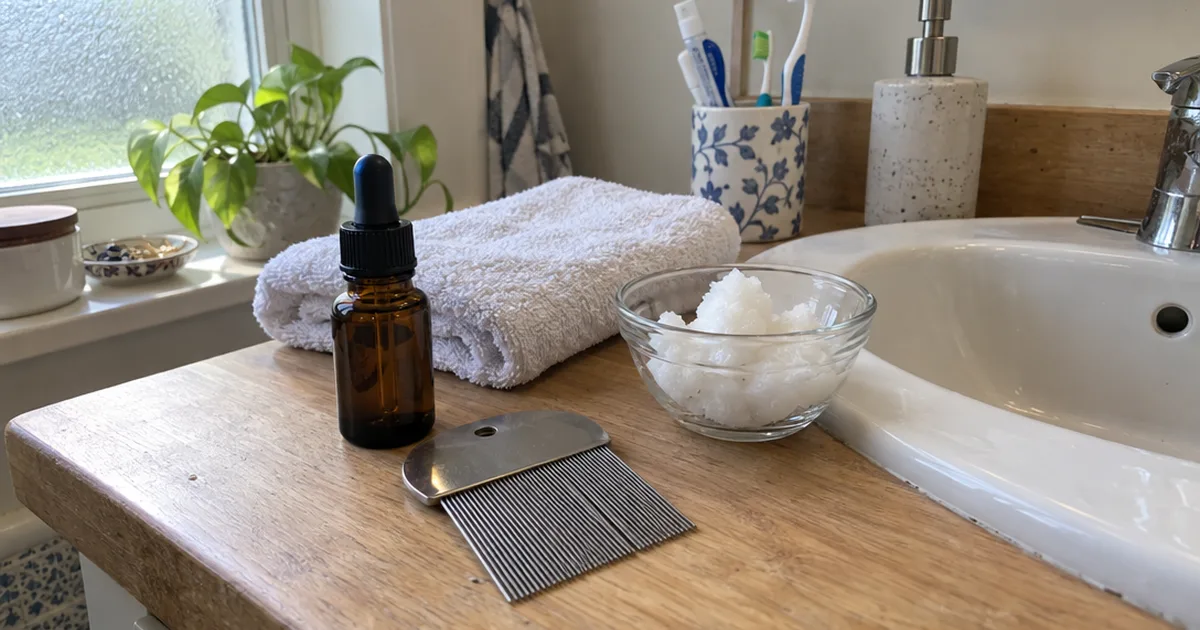

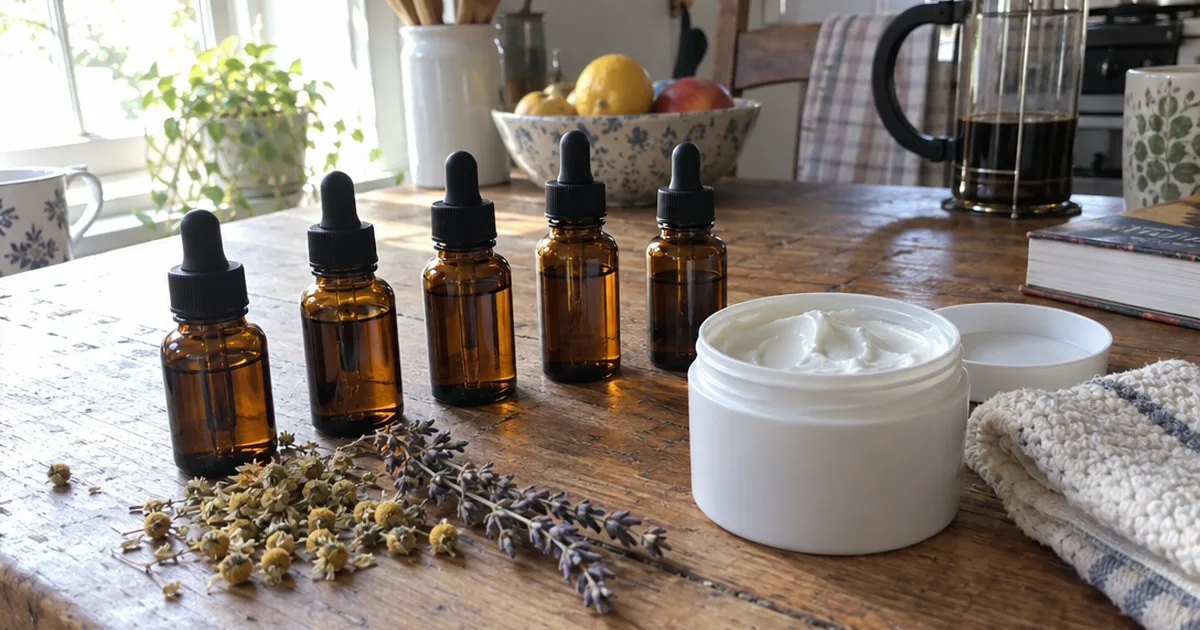
Testing one essential oil safely on eczema-prone skin takes 7 to 10 days.
That’s how long the American Academy of Dermatology (AAD) says to test any new product on your inner arm.
So the best essential oils for eczema are the ones least likely to fail that test. Below are the 5 oils people try most, ranked from the most support and fewest warnings to the least, each with who should skip it.
Quick picks:
- Calm skin and want to try one oil? Go with #1.
- If scent helps you stop scratching at night, look at #2.
- Scalp patches: #4 has one member’s success story and a dermatologist’s warning.
The 5 Best Essential Oils for Eczema at a Glance
Tap a button to jump to that oil’s full entry.
| # | Oil | What it may do | Main caution | Details |
|---|---|---|---|---|
| 1 | German chamomile | Calm inflammation | Allergy risk | See Pick |
| 2 | Lavender | Calm inflammation and stress | Fragrance allergy | See Pick |
| 3 | Frankincense | No proven effect | Thin evidence | See Pick |
| 4 | Tea tree | Lower inflammation | Can worsen eczema | See Pick |
| 5 | Calendula | Soothe skin | Irritation and allergy | See Pick |
The 5 Best Essential Oils for Eczema, Ranked by Risk
Each oil is ranked by 2 things: the support it gets from medical or patient sources, and how many of them warn against it. None was lab tested or tried by us, and none is a proven eczema treatment.
1. German Chamomile [Best Overall to Try First]
German chamomile (Matricaria chamomilla) is the best essential oil to try first for eczema. It’s known for anti-inflammatory effects, and none of the eczema avoid lists in this guide name it.
A doctor-reviewed MyEczemaTeam article, updated September 17, 2025, names chamomile as an oil known to calm inflammation. It says that may help ease eczema flares.
Lavender (#2) gets the same nod, so why rank chamomile first? Lavender earns its spot mostly through scent, and the AAD says fragrance can make eczema flare.
| German Chamomile at a Glance | |
|---|---|
| 🌿 What It May Do | Calm inflamed skin |
| 🔬 Evidence | Known anti-inflammatory effects |
| ⚠️ Main Risk | Allergic reaction |
| 🎯 Best For | Calm, unbroken skin between flares |
2. Lavender [Best for Scent-Based Calm]
Lavender is the second-best essential oil for eczema, and the better pick when scent helps you. The National Eczema Society says some people find a smell distracts them from scratching and helps them feel calm.
The same MyEczemaTeam list names lavender as an oil that calms inflammation. One member puts lavender oil on and tops it with a creamy lotion, but that’s one person’s routine, not a tested method.
| Lavender at a Glance | |
|---|---|
| 🌿 What It May Do | Calm inflammation and the urge to scratch |
| 🔬 Evidence | Known anti-inflammatory effects |
| ⚠️ Main Risk | Fragrance allergy |
| 🎯 Best For | People who scratch most when stressed |
3. Frankincense [Best Woody-Scented Option]
Frankincense is a fair third choice, but only if your skin already handles it. Its support is the thinnest of the top 3: a MyEczemaTeam member reports using frankincense essential oil mixed with a carrier oil.
That member mixed it into olive or sweet almond oil, and that part you should skip.
The National Eczema Society no longer recommends olive oil as a carrier. It also says nut oils such as almond raise your risk of a nut allergy.
| Frankincense at a Glance | |
|---|---|
| 🌿 What It May Do | No proven effect on eczema |
| 🔬 Evidence | One member's report |
| ⚠️ Main Risk | Irritation, unknown benefit |
| 🎯 Best For | People already using it without trouble |
4. Tea Tree [Best for Scalp Eczema, With Caution]
Tea tree oil is the riskiest oil here that still has some support. MyEczemaTeam says it may lower the proteins that drive inflammation.
One member reports less itch and scaling after using it with jojoba oil on the scalp. But another member says tea tree oil made their scalp worse.
Dr. Kabbur, a Cleveland Clinic dermatologist, warns that “Essential oils can sometimes cause irritation and make the problem worse.”
The same doctor names tea tree oil as an example of the hype. If you try it anyway, give it the full 7-to-10-day patch test first.
| Tea Tree at a Glance | |
|---|---|
| 🌿 What It May Do | Lower inflammation |
| 🔬 Evidence | Possible effect, mixed member reports |
| ⚠️ Main Risk | Can make eczema worse |
| 🎯 Best For | Scalp patches, after a clean patch test |
5. Calendula [Best Only If You Already Tolerate It]
Calendula ranks last because the best source on it is a warning. Dr. Anthony of Cleveland Clinic says plant creams with calendula can cause extra irritation and allergies.
So calendula only makes sense if you’ve used it on unaffected skin before with no reaction. Compared with tea tree (#4), it has no supporting finding in this guide’s sources at all.
| Calendula at a Glance | |
|---|---|
| 🌿 What It May Do | Soothe skin |
| 🔬 Evidence | None in our sources |
| ⚠️ Main Risk | Irritation and allergy |
| 🎯 Best For | People who already tolerate it |
Essential Oils to Avoid With Eczema
The essential oils to avoid with eczema fall into 5 groups that MyEczemaTeam lists as known to cause skin reactions, including allergic ones:
- Citrus oils: lemon, lemongrass, citronella, orange and lemon verbena
- Mint oils: peppermint and wintergreen
- Pepper oils: pink pepper and black pepper
- Tree-based oils: birch, pine and fir
- Other oils: basil, fennel, oregano and ginger
An oil you’ve used before can still leave a rash where it touched you, a reaction called allergic contact dermatitis. If that happens, follow the steps for an essential oil reaction and stop the oil for good.
How to Use an Essential Oil on Eczema-Prone Skin
An essential oil is only for calm, unbroken eczema-prone skin, diluted, and after a clean patch test. The National Eczema Society says not to use essential oils on broken skin at all.
How to Patch Test an Essential Oil
Patch test the exact mix you plan to use, not the plain oil. The National Eczema Society says to test on your inner arm, just below the elbow, for 3 to 5 days in a row.
The AAD gives a longer window: a quarter-sized amount on the inside of your arm every day for 7 to 10 days. I’d go with the AAD timing, since a reaction that shows up on day 6 still counts.
How Much to Dilute
Never put an essential oil on eczema undiluted, and keep the mix weak. Work out drops with this dilution guide, then patch test that exact mix.
Skip massage too. The National Eczema Society warns that rubbing inflamed or broken skin can spread infection and make inflammation worse, so dab the mix on instead.
What Carrier Oil Is Best for Eczema?
The best carrier oil for eczema is one you already tolerate, but skip olive and nut oils. Cleveland Clinic says research shows olive oil may decrease skin barrier function or even cause a fungal rash.
Nut oils such as almond are out for the allergy reason under #3. Compare the remaining options in this carrier oils for eczema guide.
Are Essential Oils Safe for a Child’s Eczema?
Essential oils are not a safe default for a child’s eczema. MyEczemaTeam, in guidance updated September 17, 2025, says to take extra care with children, especially babies.
So ask your child’s doctor before you try any oil.
Is It Safe to Diffuse Essential Oils With Eczema?
Diffusing essential oils can still bother eczema, even with no oil on your skin. The National Eczema Society says many people with eczema react to scent in the air from a candle or diffuser.
Some can’t use aromatherapy oils in any form.
So if your skin itches more in a scented room, the diffuser may be part of the problem. Turn it off for a week and see whether the itch eases.
The Bottom Line
German chamomile is the best essential oil to try for eczema, and tea tree is the one to approach most carefully.
The AAD says fragrance can make atopic dermatitis flare. So keep a fragrance-free cream or ointment as your base, and treat any oil as an extra.
If you still want to try an oil, start the 7-to-10-day patch test with chamomile this week. A rash that isn’t eczema calls for different oils for itchy skin, and the wider benefits of essential oils go well beyond skin.
Frequently Asked Questions
Can essential oils cure eczema?
No. The National Eczema Society says complementary therapies can never be a cure for eczema, though some people find them helpful alongside their regular treatment.
Keep your prescribed plan going and treat any oil as an extra you can stop at the first sign of a flare.
What is a safer alternative to essential oils for eczema?
A fragrance-free cream or ointment is the safer alternative: the American Academy of Dermatology advises one instead of a lotion, put on right after a 5-to-10-minute bath while your skin is still damp.
Skip mixing an essential oil into it, since that puts fragrance back in.
How can I smell good if I have eczema?
Choose products labeled fragrance free and keep scent off your skin. The AAD warns that unscented products only cover fragrance up, so they can still trigger a flare.
If you want a scent, test it on a small area of unaffected skin first and stop if you notice any itch or redness.
Are essential oils regulated?
No. MyEczemaTeam notes that no US government agency oversees how essential oils are harvested or processed, so quality varies from bottle to bottle.
Buy a single-oil bottle that names the plant, and patch test every new bottle, even of an oil you already use.